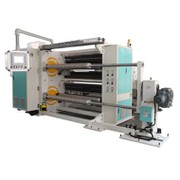
Seven Kinds Of Common Film Faults In Soft Package Slitting
Nov 14, 2020
To control the slitting quality, on the one hand, it is necessary to control and stabilize the quality of large axis film roll and raw and auxiliary materials as much as possible; on the other hand, it is more necessary to timely adjust the slitting process according to the actual situation, so as to improve the slitting quality as much as possible. The properties of different kinds of plastic films are different, and the slitting methods are also different.
Longitudinal stripe
The longitudinal stripe refers to the circumferential rib line formed on the surface of the film roll. In the slitting / rewinding process, a large amount of air entrapment and poor accumulated thickness tolerance are the main reasons for the formation of longitudinal streaks. One of the reasons is that the cutting speed is too fast. Generally speaking, quality problems such as longitudinal fringes and staggered layers are most likely to occur at high speed.
staggered floor
It refers to the phenomenon that some films are dislocated on the end face of the film roll, which is caused by the film sliding or the film width changing during the winding process. First of all, staggered layer is also related to the cutting speed. If the acceleration and deceleration are too fast, the film with good smoothness is easy to slide, resulting in staggered layer, so the speed change should be slowed down. If the film coiling is too tight, the film will slide laterally. If the film is too loose, the air will be drawn in, which will result in the staggered layers of the film coil end face. Therefore, the coiling tension should be adjusted.
Bottom wrinkle
The bottom wrinkle only occurs in the beginning of the film rewinding, which is characterized by wrinkling and deep stripes, which are caused by many factors. For example, in terms of process parameters, different types of slitting machines have different setting methods, methods and values.
For example, the old slitting machine controls the winding tension by manually adjusting the winding motor voltage and obtains the unwinding tension by using the mechanical friction resistance, while the new slitting machine uses the computer to control the winding and unwinding motor according to the input process parameters to obtain the most appropriate winding and unwinding tension. The parameter settings between the two are fundamentally different.
The performance of the equipment and the internal performance of the film have a great impact on the film slitting and winding quality, but the appropriate process can improve the quality problems such as longitudinal stripe and bottom wrinkle. Appropriate slitting process should be adopted for different equipment and different types of films. When the equipment condition changes, it can also be compensated by process adjustment, but the process adjustment must be careful.
In addition, the most important raw and auxiliary materials in slitting process are paper core and large axis film roll. Their quality not only affects the slitting speed, but also is closely related to the problems such as longitudinal stripe and bottom wrinkle. Therefore, it is necessary to strengthen the monitoring by combining process control, incoming inspection and final inspection, so as to stabilize the quality of major axis film roll and raw and auxiliary materials
Edge warping
Edge warping occurs at the edge of film winding, which means that the edge of thin film is warped by winding and superposition. The common reason is that the cutter is too blunt, and there is tension at the incision during slitting, which causes the film roll edge to turn outward after rewinding, resulting in edge warping. At this time, the cutter should be replaced in time to avoid the occurrence of edge warping. If the cutter is not installed correctly, the coiling speed is too fast and the coiling is too tight, it is easy to cause warping.
Fulminant tendon
The rib is an obvious protuberance formed on the surface of the film due to the accumulation of the film thickness tolerance. This is mainly caused by the quality of the film itself. The quality of the film itself refers to the quality of the film which has been cut or cut again, such as the thickness tolerance of the film, the winding state of the film, etc., all have an important impact on the apparent quality of the slitted film. Even after slitting / rewinding, the poor quality film can not obtain satisfactory apparent quality.
Slitting can only improve local problems, but not all problems. In order to obtain good product appearance and winding quality, on the one hand, proper adjustment should be made during slitting, on the other hand, the quality of previous film-forming process must be improved.
Insufficient length and excessive width deviation
This is due to the wrong winding count or the insufficient length of the cut film, as well as the incorrect positioning of the equipment. In order to meet the needs of users to get a certain length of film, under normal circumstances, the operator can get the winding length from the data display on the winder.
However, the film is often broken and part of the film on the surface of the large axis film roll is often cut. If the length is calculated and matched according to the marked length, and it is found that the length is not enough and cannot be spliced at last, the whole vehicle products can not be genuine products, especially the slitter whose width is more than 1 m, which will cause greater economic loss.
In order to avoid this kind of situation, the length of the large axis film roll with the same model, specification and process should have a certain corresponding relationship with the film coil diameter. As long as the measured diameter data is compared with the winding length after the machine is put on the machine, we can roughly know whether the roll length meets the requirements. If the difference is large, we should pay attention to the splicing length when cutting to avoid the phenomenon of insufficient length Health.
There are dust and even flying insects in the film roll
In the process of slitting, the film needs to be re opened and then rewinding, which creates conditions for the entry of foreign matters. Because many film products need direct contact with food, medicine and so on, so the hygiene requirements are very strict. The purified production workshop is very important to ensure that the products are clean and good.